
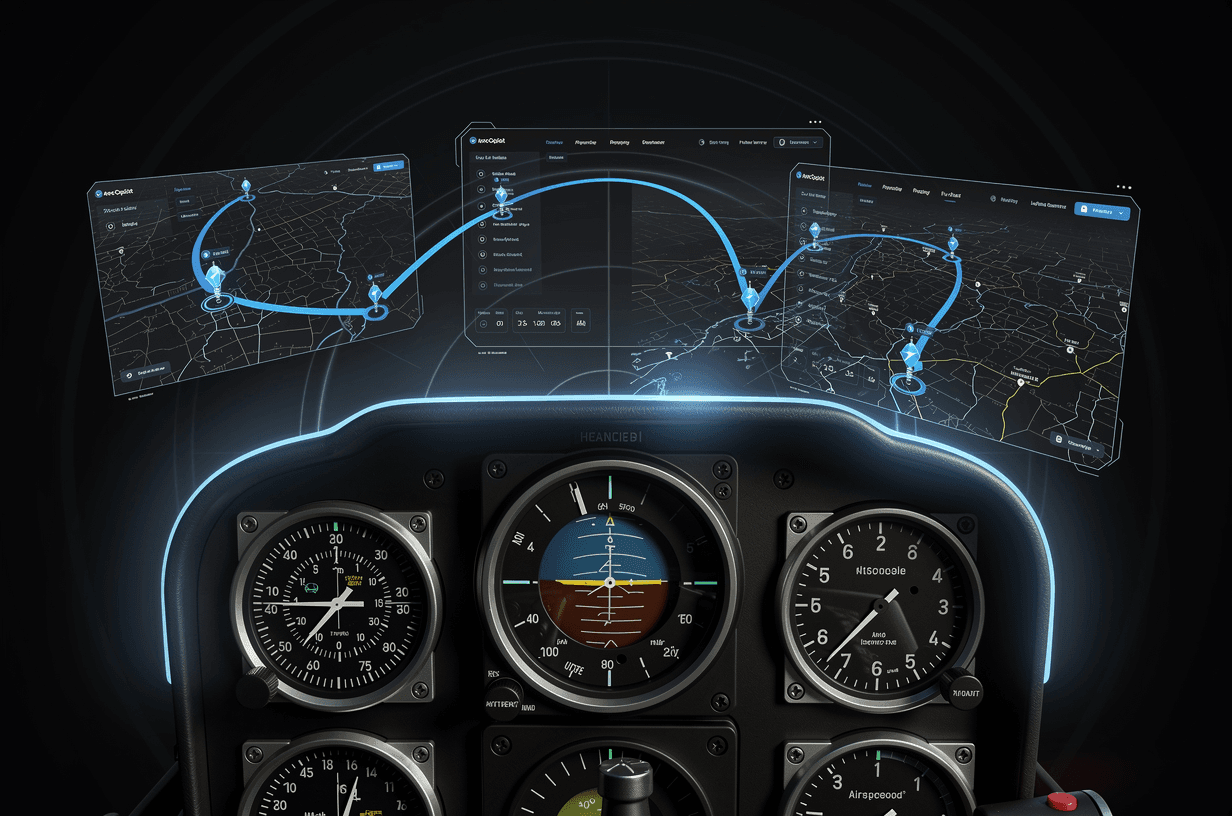
There's a question that every founder, CTO, and investor eventually asks: "How fast can we actually build this?" The honest answer, until recently, was "slower than you want and more expensive than you expect." AeroCopilot is the case study that rewrites that answer.
One developer. AI-native tooling. 3.5 months. The result: a fully compliant aviation SaaS platform with 173 database tables, 444 migrations, 3,893 commits, and real paying customers. This is not a prototype sitting in a demo environment—it's a production system audited by a commander with over 12,000 flight hours.
Here's exactly how it happened.
What Is AeroCopilot?
AeroCopilot is a SaaS platform for Brazilian general aviation. It handles flight planning, fuel calculations, NOTAM decoding, METAR weather interpretation, weight-and-balance computations, and regulatory compliance documentation—all in one integrated system.
Aviation software is notoriously complex. Flight plans must conform to ICAO standards (the International Civil Aviation Organization's global framework). Fuel calculations must achieve 100% DECEA compliance—DECEA being Brazil's Department of Airspace Control, operating under ANAC (Brazil's National Civil Aviation Agency), the authority that governs every flight in Brazilian airspace. A single error in fuel planning isn't a bug report; it's a safety incident.
This isn't a todo app. This is life-critical software with zero tolerance for miscalculation.
The Numbers That Matter
Let's start with the raw metrics, because they tell a story traditional development can't:
- 3,893 total commits across the codebase
- 173 database tables with complex relational models
- 444 database migrations, reflecting rapid iteration without architectural compromise
- 65 published blog posts driving SEO and authority
- 4,400+ pages indexed by Google
- Free tools (METAR decoder, NOTAM decoder) generating inbound traffic
- 100% DECEA fuel compliance, audited and verified
- ICAO-conformant flight plans, meeting international standards
Built by Meld's co-founder—a solo developer leveraging AI-native workflows powered by DuranteOS—in approximately 3.5 months of development time.
What Traditional Development Would Have Required
We estimate that building AeroCopilot with a conventional team and traditional workflows would have required 25 to 35 developers working 12 to 18 months. Here's the breakdown:
- Backend team (6-8 engineers): 173 tables don't design themselves. Schema design, API development, migration management, and data integrity for aviation-grade software requires senior database architects and backend engineers.
- Frontend team (5-7 engineers): Complex dashboards, real-time weather displays, interactive flight planning maps, and responsive design across devices.
- Aviation domain specialists (2-3): ICAO conformance, DECEA fuel regulations, weight-and-balance physics, NOTAM/METAR parsing logic.
- QA team (3-4 engineers): Regulatory compliance testing, edge case validation, regression testing across 173 tables of interconnected data.
- DevOps (2-3 engineers): Infrastructure, CI/CD, monitoring, security hardening for a platform handling flight safety data.
- Content team (3-4 people): 65 blog posts, SEO strategy, free tool development, documentation.
- Project management (2-3): Coordination across all teams, sprint planning, stakeholder communication.
At average US agency rates, that's $1.5M to $3M in development costs. At offshore rates, you're still looking at $400K to $800K. Meld's co-founder built it for a fraction of that—a dramatic illustration of how AI-native development cuts MVP costs by 60%.
The AI-Native Approach
AeroCopilot wasn't built by replacing developers with ChatGPT. It was built using AI-native development methodology—a fundamentally different approach where AI is embedded into every stage of the development lifecycle.
Architecture and Schema Design
With 173 database tables, schema design is where most projects stall. AI-assisted architecture allowed Meld's co-founder to model complex aviation domain relationships—aircraft performance profiles, fuel burn curves, waypoint networks, airspace classifications, regulatory rule sets—and iterate on the schema rapidly. The 444 migrations reflect continuous refinement, not reckless churn.
Regulatory Compliance
This is where AI-native development proved its deepest value. Aviation regulations are dense, interconnected, and unforgiving. AI tooling helped with:
- Parsing DECEA regulatory documents and translating requirements into validation logic
- Cross-referencing ICAO standards and FAA regulations against implementation details
- Generating comprehensive test suites for fuel calculation edge cases
- Auditing compliance gaps before human review
The result—100% DECEA fuel compliance verified by a 12,000+ flight-hour commander—isn't just impressive. It's the kind of validation that normally takes months of back-and-forth between engineering teams and domain experts.
Content and SEO at Scale
65 blog posts. Free METAR and NOTAM decoder tools. 4,400 indexed pages. This content strategy wasn't an afterthought—it was built in parallel with the product, leveraging AI to draft, refine, and optimize technical aviation content that drives organic discovery.
Most SaaS products launch with a landing page and a prayer. AeroCopilot launched with an entire content ecosystem.
The Tech Stack
AeroCopilot runs on a modern, production-grade stack:
- Next.js 16 with App Router and React Server Components
- React 19 with the latest concurrent features
- TypeScript end-to-end, no exceptions
- Supabase for database, auth, and real-time capabilities
- Tailwind CSS for rapid, consistent UI development
- 18 monorepo packages providing clean separation of concerns
The monorepo architecture deserves attention. 18 packages means the codebase is modular, testable, and maintainable. This isn't spaghetti code that happens to work—it's engineered software with clear boundaries, shared libraries, and independent deployment capabilities.
What This Proves
AeroCopilot is proof of a thesis that the software industry is only beginning to internalize:
1. Solo Developers Can Build Enterprise-Grade Software
The myth that complex software requires large teams is exactly that—a myth. With AI-native tooling, a skilled developer with domain knowledge can architect, build, test, and ship software that rivals what 30-person teams produce. This is the essence of the solo architect era—the bottleneck was never typing speed; it was cognitive bandwidth. AI expands that bandwidth dramatically.
2. Speed and Quality Are No Longer Trade-Offs
The old iron triangle—fast, good, cheap, pick two—assumed human-only labor. AI-native development breaks the triangle. AeroCopilot shipped fast (3.5 months), at high quality (regulatory compliance, 18-package monorepo), and at a fraction of traditional cost. You don't have to pick two anymore.
3. Domain Complexity Is Solvable
Aviation is one of the most regulated industries on earth. If AI-native development can produce compliant aviation software, it can handle your fintech compliance, your healthcare HIPAA requirements, your logistics optimization. The domain doesn't matter—the methodology scales.
4. Content Is a Product Feature
4,400 indexed pages and 65 blog posts aren't marketing—they're product surface area. Free METAR and NOTAM decoders bring pilots to the platform. Blog content establishes authority. SEO compounds over time. AeroCopilot's growth engine was built into the product from day one.
The Meld Connection
Meld is an AI-native development studio based in Tampa and Lakeland, Florida. AeroCopilot is both a product and a proof of methodology—the same AI-native approach Meld uses to build MVPs for clients in 4 to 8 weeks.
When Meld tells a founder "we can build your MVP in 6 weeks for $25K," AeroCopilot is the receipts. Not a slide deck. Not a hypothetical. A production SaaS with paying customers, regulatory compliance, and nearly 4,000 commits of evidence. Learn more about our 8-week idea-to-revenue process.
What Comes Next
AeroCopilot continues to grow. The platform is expanding its user base. The content flywheel is compounding. And the platform itself continues to expand—new aircraft profiles, enhanced weather integration, mobile optimization, and deeper regulatory automation.
But the bigger story isn't about one aviation SaaS. It's about what becomes possible when you stop building software the old way. The 25-to-35-person team is optional now. The 12-to-18-month timeline is optional. The million-dollar budget is optional.
What's not optional is the skill to wield AI-native development effectively. That's the difference between a developer using Copilot for autocomplete and a developer building a regulated SaaS platform solo in 3.5 months.
AeroCopilot is the line in the sand. Everything built before it was the old way. Everything after it has no excuse.