
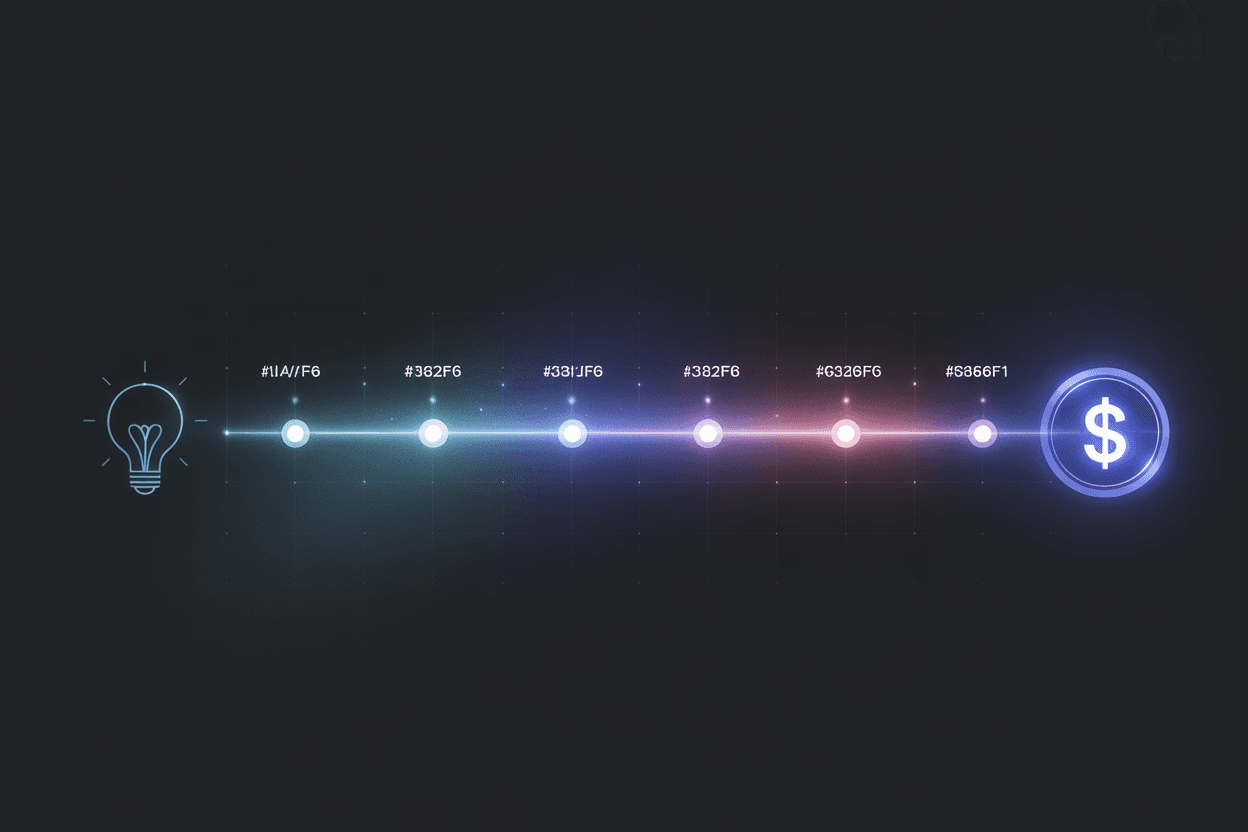
Most startups die waiting. They spend six months writing specs, another six building, and by the time they launch, the market has moved on or the money has run out. At Meld, we've compressed the entire journey—from first conversation to paying customers—into eight weeks.
This isn't a gimmick. It's a deliberate process built on two decades of engineering experience, a quarter century of go-to-market strategy, and the most significant force multiplier software has ever seen: AI-native development.
Here's exactly how we do it.
Week 0: Discovery and Qualification
Every engagement starts with a conversation, not a contract. We run a structured discovery call designed to answer three questions fast:
- Is the budget realistic? Our builds range from $15K to $50K. (See our full breakdown of the true cost of building an MVP in 2026.) If someone needs a $500K enterprise platform, we're not the right fit. If someone wants a production MVP that can generate revenue and attract investors, we are.
- Is the timeline aligned? We deliver in 4–8 weeks. Founders who need something yesterday or aren't ready to start for three months aren't ideal partners for this model.
- Is the decision maker in the room? We've learned the hard way that building by committee kills momentum. We need a founder or co-founder who can make calls quickly.
During Week 0, we also do preliminary market and technical research. By the time we shake hands, we already have a rough mental model of the architecture.
The goal of Week 0 isn't to sell—it's to make sure we can actually deliver something that matters.
Week 1: Event Storming + Architecture Design
This is where the real work begins. We run a collaborative Event Storming workshop with the founding team—typically a half-day session where we map every meaningful event in the system.
What does the user do? What triggers what? Where does money flow? Where do permissions matter? We capture all of it on a virtual board using sticky notes organized by domain.
From that workshop, we produce three artifacts:
- Domain model — the bounded contexts, aggregates, and key entities
- Architecture blueprint — tech stack selection, infrastructure decisions, integration points
- Sprint plan — a week-by-week breakdown of what gets built and when
Tech Stack Selection
We don't debate frameworks for fun. We pick proven tools that let us move fast without accumulating debt:
- Next.js for the application layer (server components, API routes, edge deployment)
- PostgreSQL as the primary data store
- Prisma for type-safe database access
- Tailwind CSS for rapid UI development
- Better Auth or equivalent for authentication and authorization
- Cloud deployment on Vercel, AWS, or Railway depending on the product's needs
Every choice is made to maximize velocity in Weeks 2–6 and minimize regret in Months 6–12.
Week 2: Foundation Sprint
Week 2 is infrastructure week. Nothing user-facing ships, but everything that follows depends on what we build here:
- Authentication and authorization — login, signup, roles, permissions, multi-tenancy if needed
- Database schema and migrations — initial models based on the domain model from Week 1
- CI/CD pipeline — automated testing, linting, preview deployments on every PR
- Design system — core components, typography, color tokens, spacing scale
- Monitoring and error tracking — so we catch problems before users do
By Friday of Week 2, we have a deployed application that does almost nothing—but does it on a rock-solid foundation. This is the sprint most agencies skip, and it's why their projects fall apart at Month 3.
Weeks 3–4: Core Feature Development
Now we build the product. These two weeks are pure feature velocity, and this is where AI-native development changes the equation most dramatically.
Every Friday, the founding team gets a live demo. Not a slide deck. Not a Loom video. A working deployment they can click through, test, and give feedback on. This cadence keeps expectations aligned and eliminates the "that's not what I meant" moment that plagues traditional development.
During Weeks 3–4, we typically ship:
- The primary user workflow end-to-end
- Dashboard and data visualization
- Core business logic and validation
- Role-based access for different user types
- Mobile-responsive layouts
How AI Accelerates This Phase
Our senior architects use AI as a force multiplier across every task. Code generation handles the boilerplate. AI-assisted code review catches issues before they reach main. Automated test generation covers edge cases a human would skip under time pressure.
The result: we estimate AI accelerates each phase by 40–60%. That's not a marketing number—it's what we observe sprint over sprint when comparing AI-native workflows to traditional development timelines. The AeroCopilot case study is the most dramatic proof point—3,893 commits in 3.5 months by a single developer.
Weeks 5–6: Integration Sprint
A product that can't take payments, send emails, or talk to third-party services isn't a product. Weeks 5–6 are dedicated to making the MVP a complete, revenue-capable system:
- Payment processing — Stripe integration with subscription management, invoicing, and webhook handling
- Transactional email — welcome sequences, password resets, notifications, receipts
- Analytics — event tracking, funnel visualization, key metric dashboards
- Third-party API integrations — whatever the product needs to connect to (CRMs, ERPs, data providers, AI services)
- File storage and media handling — uploads, processing, CDN delivery
Each integration follows the same pattern: we build an abstraction layer so the founding team isn't locked into any single vendor. Swap Stripe for Paddle later? Change email providers? The interfaces are clean enough to make that painless.
Week 7: QA, Performance, and Documentation
Week 7 is about polish and resilience. We shift from building features to stress-testing everything we've built:
- End-to-end testing with Playwright across critical user paths
- Performance optimization — bundle analysis, image optimization, database query profiling, caching strategies
- Security review — input validation, rate limiting, CORS configuration, dependency auditing
- Documentation — API docs, deployment runbooks, architecture decision records, onboarding guides for future developers
This is the week where a product goes from "demo-ready" to "production-ready." The difference matters enormously when real users and real money are involved.
Week 8: Launch
Week 8 is deployment day and everything that surrounds it:
- Production deployment to the final infrastructure environment
- DNS, SSL, and domain configuration
- Complete code ownership transfer — the founding team gets the full repository, all credentials, and all infrastructure access
- Launch support — we're available in real-time on launch day to handle anything that comes up
- Monitoring setup — alerts for errors, performance degradation, and usage spikes
By the end of Week 8, the founding team owns a production SaaS that can acquire customers, process payments, and generate revenue. Not a prototype. Not a "v0.1." A real product.
Post-Launch: 90 Days of Support
Every Meld engagement includes 90 days of post-launch support at no additional cost. This covers:
- Bug fixes and critical patches
- Minor adjustments based on early user feedback
- Infrastructure scaling guidance as traffic grows
- Technical advisory for the founding team's next hiring decisions
After the 90-day window, we offer an optional monthly retainer for teams that want ongoing development support without hiring a full-time engineering team. Many of our clients stay on retainer for 6–12 months as they find product-market fit and scale.
Why This Works
The traditional agency model is broken in a specific way: it optimizes for billing hours, not for outcomes. A 20-person team working for six months will always find ways to fill six months of work, whether or not the product needs it.
Our model is the inverse. Two senior architects, AI-native tooling, and a ruthless focus on what matters for launch. We don't build features that won't matter until Month 6. We don't over-architect for scale the product hasn't earned yet. We build the smallest thing that can generate revenue, and we build it on a foundation that won't collapse when growth arrives.
If you're a founder sitting on an idea that's been "almost ready" for too long, the math is simple: eight weeks and $15–50K gets you a product in market. Everything else is a conversation about what happens after the first customers show up.
That's a conversation worth having. Get in touch and let's talk about your Week 0.