
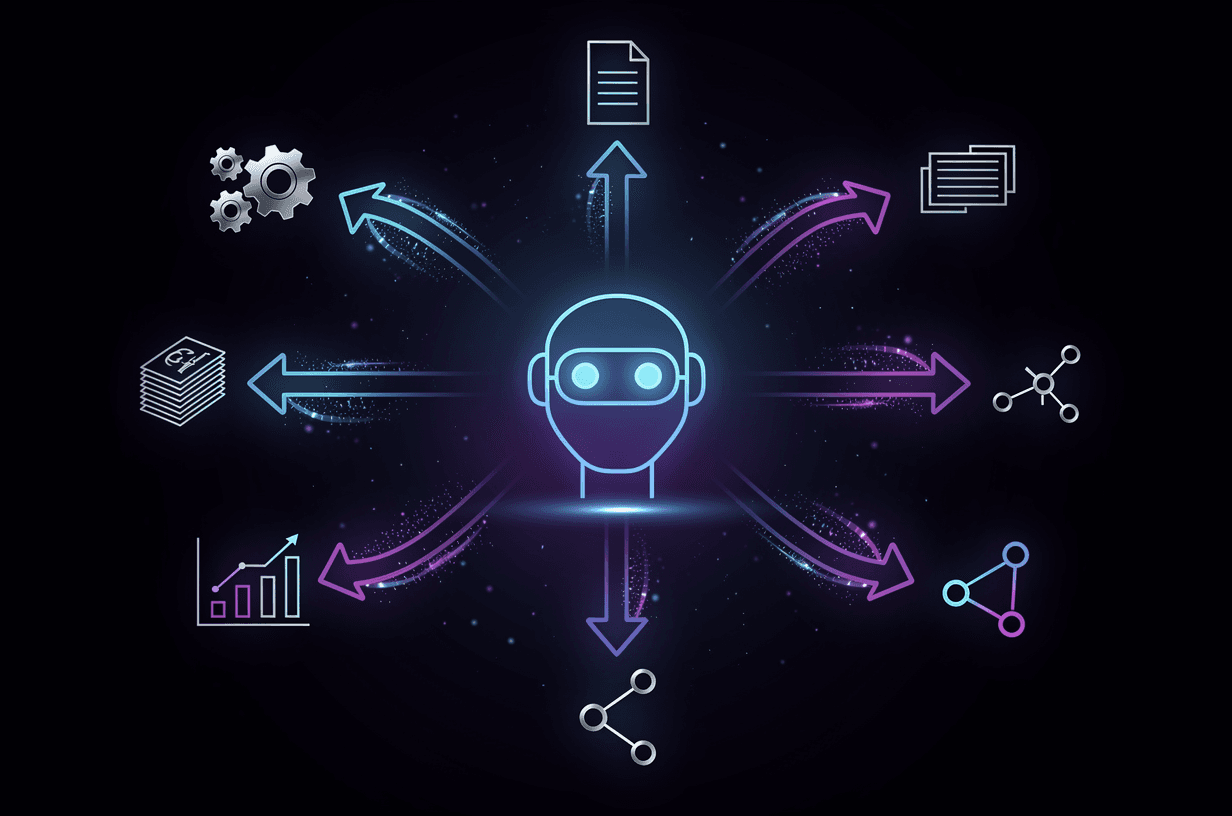
The AI landscape shifted dramatically between 2024 and 2026. We went from chatbots that answer questions to AI agents that complete entire workflows autonomously. The difference is not incremental — it is architectural. A chatbot waits for your prompt. An agent sets goals, selects tools, executes multi-step plans, and delivers results without hand-holding.
If you are building a business in 2026 and not evaluating where AI agents fit into your operations, you are already behind. This guide covers what AI agents actually are, five concrete business applications, the architecture patterns that make them work, and how to decide between building custom agents or buying off-the-shelf solutions.
What AI Agents Actually Are
An AI agent is software that combines three capabilities that chatbots lack:
- Autonomy — it operates without step-by-step human instruction
- Goal-direction — it works toward a defined objective, not just a single prompt
- Tool use — it calls APIs, queries databases, writes files, browses the web, and executes code
Think of the difference this way: a chatbot is a calculator. An AI agent is an accountant. The calculator does exactly what you ask. The accountant understands the goal (minimize tax liability), selects the right tools (tax code, financial statements, depreciation schedules), executes a multi-step plan, and delivers a complete result.
The most capable agents in 2026 also exhibit reflection — they evaluate their own outputs, catch errors, and retry with improved strategies. This is the leap that moved agents from demos to production.
At Meld, we use an internal AI agent system called DuranteOS that orchestrates development workflows. It coordinates code generation, testing, documentation, architecture decisions, and deployment across complex projects. A single developer working with this agent system produced AeroCopilot — a 173-table SaaS platform — in 3.5 months. That is the productivity multiplier agents deliver when built correctly.
Five Business Applications That Work Today
1. Customer Service Agents
The most mature application. Modern customer service agents go far beyond scripted FAQ bots. They access your CRM, read order history, process refunds, escalate edge cases, and maintain context across conversations. Companies like Coca-Cola and Microsoft have deployed agent systems that handle 60-80% of tier-1 support volume without human intervention.
The key difference from 2024-era chatbots: these agents take action. They do not just tell the customer what to do — they do it. Cancel the subscription. Issue the credit. Update the shipping address. The resolution happens inside the conversation.
2. Data Processing and Analysis Agents
Every business drowns in data. Agent systems now ingest raw data from multiple sources (spreadsheets, APIs, databases, PDFs), clean and normalize it, run analysis, generate reports, and surface insights. A financial services firm might deploy an agent that pulls transaction data, identifies anomalies, cross-references compliance rules, and produces a flagged-items report — all triggered by a daily schedule, no human involved.
The cost savings are dramatic. What required a 3-person data team working 40 hours per week now runs autonomously with human review only on flagged exceptions.
3. Sales Outreach Agents
Sales development representatives spend 70% of their time on research, email drafting, and follow-up sequences. Agent systems now handle the entire top-of-funnel: research the prospect's company, identify pain points from public data, draft personalized outreach, manage follow-up cadences, and route warm leads to human reps.
Avenue Code and similar technology consultancies have reported 3-4x pipeline growth after deploying AI-powered outreach systems that operate continuously rather than during business hours only.
4. Content Creation Pipelines
Not just "write me a blog post." Production-grade content agents manage entire editorial calendars. They research topics, analyze search intent, draft content, optimize for SEO, generate images, format for CMS publishing, and distribute across channels. Our work with AeroCopilot's content strategy produced 65 blog posts and grew the site to 4,400 indexed pages using agent-driven content pipelines.
The critical nuance: the best content agents include human review gates. The agent does 90% of the work. A human editor reviews, adjusts voice, and approves. This hybrid approach produces better output than either fully manual or fully automated workflows.
5. Code Generation and Development Agents
This is where we live at Meld. Development agents do not just autocomplete code — they understand project architecture, follow coding standards, write tests, run CI/CD pipelines, and fix their own bugs. The DuranteOS pattern we use internally coordinates multiple specialized agents: one for architecture decisions, one for implementation, one for testing, one for documentation.
The result is not replacing developers. It is making each developer 5-10x more productive. A solo developer with agent tooling now ships what previously required a team of five. That changes the economics of every startup build decision.
Architecture Patterns That Work
ReAct (Reasoning + Acting)
The most proven pattern. The agent alternates between reasoning steps (thinking about what to do) and action steps (executing tools). Each observation from an action feeds into the next reasoning step. This creates a transparent chain of thought that is debuggable and auditable.
ReAct works well for complex, multi-step tasks where the path to completion is not fully known in advance. Customer service, data analysis, and research tasks all benefit from this pattern.
Tool-Calling Architecture
The agent has access to a defined set of tools (APIs, functions, database queries) and selects which ones to call based on the current goal. The LLM acts as the orchestration layer — it decides what to do, but the actual work happens in deterministic tool executions.
This pattern is critical for production reliability. The LLM handles reasoning and planning. The tools handle execution with predictable, testable behavior. You get the flexibility of AI with the reliability of traditional software.
Multi-Agent Systems
Instead of one agent doing everything, you deploy specialized agents that collaborate. A coordinator agent breaks the task into subtasks and delegates to specialist agents. One agent handles data retrieval, another handles analysis, a third handles report generation.
This is the pattern behind DuranteOS and similar production systems. Specialization produces better results than generalist agents, and the modular architecture makes the system easier to test, debug, and improve incrementally.
Build vs. Buy: The Decision Framework
The build-vs-buy decision for AI agents depends on three factors:
Build custom when:
- Your workflow is unique to your industry or business model
- You need deep integration with proprietary systems
- Data sensitivity prevents using third-party platforms
- The agent is a core competitive advantage
Buy off-the-shelf when:
- The use case is common (customer service, email, scheduling)
- Time-to-value matters more than customization
- You lack internal AI/ML expertise
- The workflow is standardized across your industry
Hybrid approach (most common):
- Use a platform for the agent framework and orchestration
- Build custom tools and integrations for your specific data and systems
- This gets you 80% of custom value at 30% of the cost
Cost Ranges in 2026
Realistic budgets for AI agent projects:
- Simple single-agent automation (customer service bot, data pipeline): $15K-$40K
- Multi-agent workflow system (sales pipeline, content engine): $40K-$100K
- Enterprise agent platform (custom orchestration, multiple departments): $100K-$300K
- Ongoing operation costs (LLM API calls, infrastructure): $500-$5,000/month depending on volume
These numbers reflect the dramatic cost reduction that AI-native development has brought to software projects overall. Two years ago, similar capabilities required $500K+ and a dedicated ML engineering team.
What Comes Next
The agent landscape is evolving fast. Three trends to watch:
- Agent-to-agent protocols — standardized ways for agents from different companies to collaborate, similar to how APIs standardized service-to-service communication
- Persistent memory — agents that learn from every interaction and improve continuously, not just within a single session
- Regulatory frameworks — as agents take more autonomous action, compliance and auditability requirements will shape architecture decisions
The businesses that start building agent capabilities now — even simple ones — will have a structural advantage over competitors who wait. The learning curve is real, and organizational muscle memory for working with agents takes time to develop.