
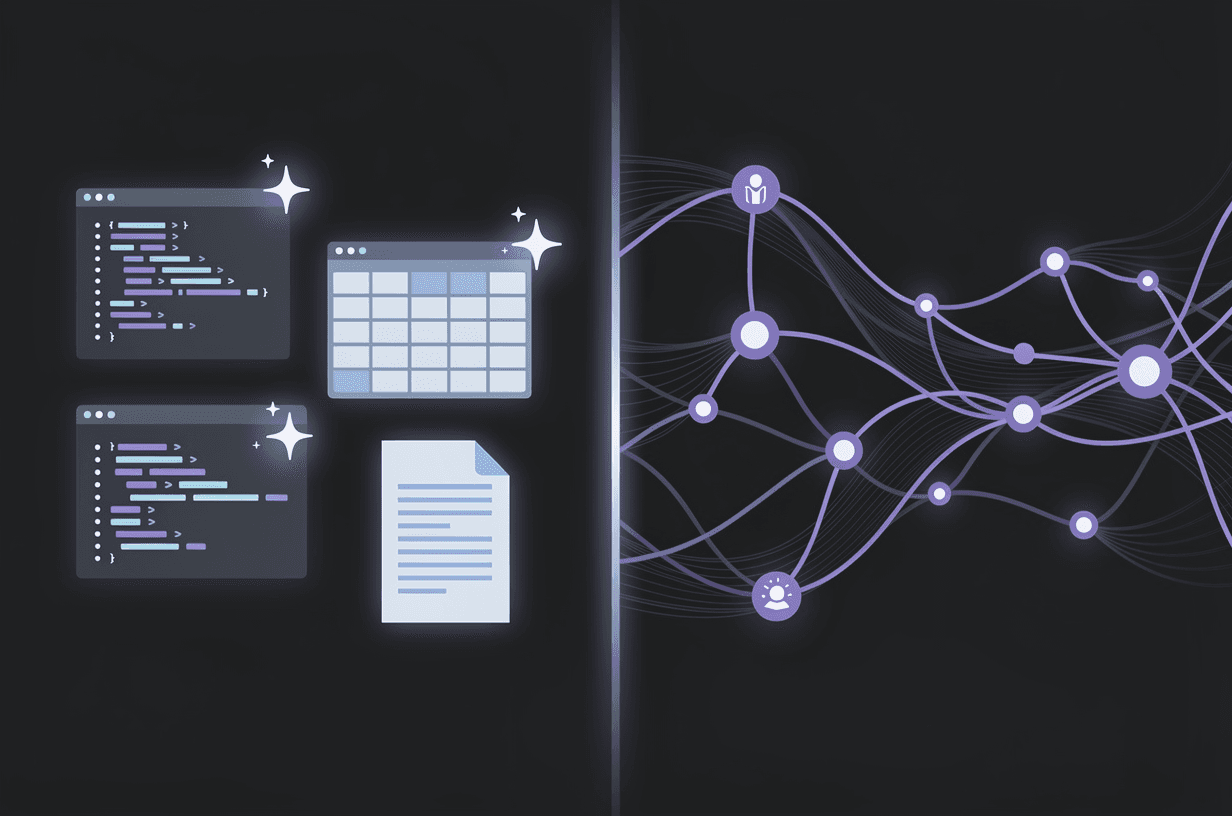
Every software agency in 2026 claims to "use AI." It's the table stakes phrase of the year, plastered across every landing page and sales deck in the industry. But when you dig beneath the marketing, there's a fundamental divide that most buyers don't see—and it's the difference between saving 20% on your project and saving 80%.
The divide is between AI-augmented development and AI-native development. They sound similar. They are radically different. And choosing the wrong one will cost you months, money, and momentum.
What Is AI-Augmented Development?
AI-augmented development is the approach most agencies use today. Take a traditional development team and hand them AI tools. The process stays the same. The team structure stays the same. The project management methodology stays the same. AI just makes individual developers faster at specific tasks.
Here's what it looks like in practice:
- Same team size. You still have a project manager, 3-5 developers, a QA engineer, a designer. Everyone has their role. AI doesn't change the org chart.
- AI as autocomplete. Developers use GitHub Copilot, Cursor, or ChatGPT to write code faster. They still write the same code—they just type less.
- Traditional planning. Sprint planning, ticket estimation, standup meetings, retrospectives. The ceremony is identical to a non-AI project.
- Same timeline, slightly cheaper. A project that would take 6 months takes 4-5 months. A team of 8 becomes a team of 6. Savings of 20-30%.
There's nothing wrong with AI-augmented development. It's a genuine improvement over 2023-era workflows. Developers produce more code per hour. Code review goes faster. Boilerplate disappears. But the fundamental economics haven't changed—you're still paying for human hours, and humans are still the bottleneck.
Think of it like giving a horse-drawn carriage a better horse. You go faster. But you're still on a carriage.
What Is AI-Native Development?
AI-native development doesn't add AI to an existing process. It rebuilds the entire development pipeline around AI as the primary producer of code, tests, and documentation—with senior human architects providing judgment, direction, and quality control.
Here's what it looks like:
- Radically smaller teams. One architect with AI replaces a traditional team of 25-35 people. This isn't a theoretical claim—it's exactly what happened with AeroCopilot, where a single developer shipped a 173-table aviation SaaS in 3.5 months.
- AI as the primary builder. AI doesn't assist the developer—it generates the majority of code, tests, and documentation using platforms like Anthropic's Claude and OpenAI's models. The architect's role is to design, review, direct, and refine.
- Architecture-first workflow. Instead of translating specs into tickets into code, the architect defines domain models, bounded contexts, and system contracts—then AI implements them directly.
- Compressed timelines. Projects that took 12-18 months take 8-14 weeks. Not because anyone is cutting corners, but because the ratio of thinking-to-typing inverted completely.
- Fundamentally different cost structure. You're not paying for 8 developers × 6 months. You're paying for 1-2 architects × 2-3 months. The math is transformative.
This is the automobile replacing the carriage. Same destination, completely different vehicle.
The Five Key Differences
1. Architecture Approach
AI-augmented: Architecture is designed upfront by a team, documented in specs, and implemented over weeks. Changes to architecture are expensive because they require coordinating multiple developers.
AI-native: Architecture is co-designed with AI in rapid iteration loops. An architect can prototype three different approaches in a day, evaluate them against real data, and commit to the best option with evidence. Architectural pivots that would derail a traditional team for weeks happen in hours.
This is why AI-native teams produce better architecture, not just faster delivery. When experimentation is cheap, you explore more options and find better solutions.
2. Team Structure
AI-augmented: Traditional pyramid. A few seniors, several mid-levels, many juniors. Coordination overhead grows with team size. Brooks's Law still applies—adding people to a late project makes it later.
AI-native: Inverted pyramid. One or two senior architects making all meaningful decisions, with AI handling implementation at scale. Zero coordination overhead between humans. Zero context-switching cost. Zero "let me check with the other team" delays.
The solo architect era isn't about ego—it's about eliminating the communication tax that eats 30-50% of every traditional team's capacity.
3. Cost Model
AI-augmented: Cost = (team size × hourly rate × duration) - 20-30% efficiency gain. A $500K project becomes a $375K project. Real savings, but not transformative.
AI-native: Cost = (1-2 architects × compressed timeline) + AI infrastructure costs. A $500K project becomes a $75K-150K project. The economics shift by 3-5x, not 20-30%.
Here's a concrete comparison for a mid-complexity SaaS platform:
| Factor | AI-Augmented | AI-Native |
|---|---|---|
| Team size | 6-8 people | 1-2 people |
| Timeline | 4-5 months | 8-12 weeks |
| Total cost | $300K-500K | $75K-150K |
| Architecture quality | Good | Often superior |
| Iteration speed | Weekly sprints | Daily cycles |
The real cost breakdown for AI-native MVPs is worth studying if you're comparing proposals from different agencies.
4. Development Speed
AI-augmented: 20-30% faster than traditional. A 6-month project finishes in 4.5 months. Meaningful, but the same order of magnitude.
AI-native: 300-400% faster than traditional. A 12-month project finishes in 3 months. Different order of magnitude entirely. This isn't incremental improvement—it's a phase change.
The speed difference compounds over iterations. An AI-native team can ship a feature, test it with users, gather feedback, and ship improvements in the time an AI-augmented team is still in sprint planning for the first version.
5. Quality Characteristics
AI-augmented: Quality depends on the team's skills and processes, slightly improved by AI-assisted code review and testing. The quality profile is similar to traditional development—some good, some mediocre, depending on who you hire.
AI-native: Quality is more consistent because one architect maintains the entire system's mental model. No knowledge silos. No "the person who built that module left." No inconsistencies between how different developers interpreted the same spec. The architect sees everything, and AI enforces consistency.
The counterintuitive result: AI-native projects often have better code quality than augmented ones, because a single architect with AI can maintain structural coherence that a 10-person team struggles with.
Why Most Agencies Are Augmented, Not Native
If AI-native is demonstrably faster and cheaper, why don't all agencies do it? Three reasons:
Business model conflict. Agencies bill by the hour or by the headcount. AI-native development requires fewer hours and fewer people. Telling a client "we'll do it in 8 weeks with one person" generates less revenue than "we'll do it in 5 months with a team of eight." Most agencies won't cannibalize their own revenue model.
Talent gap. AI-native development requires architects who can operate across the entire stack—backend, frontend, infrastructure, domain modeling, testing—at a senior level. These people are rare. It's much easier to hire six specialists than one polymath.
Organizational inertia. Agencies have project managers, scrum masters, QA teams, and DevOps departments. Rebuilding around AI-native delivery means restructuring the entire organization. Most won't do it until market pressure forces them.
How to Tell the Difference When Evaluating Agencies
When an agency says they "use AI in development," ask these five questions:
"How many people will work on my project?" If the answer is 6+, they're augmented. AI-native teams are 1-3 people for most projects.
"Who makes the architectural decisions?" If it's "the team decides in sprint planning," they're augmented. AI-native means a single architect owns the system design.
"How fast can you ship the first working version?" If it's 2-3 months, they're augmented. AI-native teams ship a functional core in 2-4 weeks.
"How do you handle architectural changes mid-project?" If the answer involves change requests, re-estimation, and timeline impacts, they're augmented. AI-native teams pivot architecturally in days because the cost of exploration is low.
"Can I see a case study with metrics?" Augmented agencies show you polished portfolios. AI-native agencies show you commit counts, deployment frequencies, and timeline comparisons. Ask for the numbers.
Meld's AI-Native Approach
At Meld, we don't add AI to a traditional process. We are a Tampa-based AI development agency that rebuilt the process from the ground up.
Our AeroCopilot case study is the proof point: one architect, AI-native methodology, 3.5 months, and the result was a production SaaS platform with 173 database tables, 444 migrations, 3,893 commits, full ICAO/DECEA regulatory compliance, and paying customers. A traditional team would have needed 25-35 people and 12-18 months to produce the same output.
That's not 20% faster. That's a fundamentally different category of delivery.
The question for your next project isn't whether your agency uses AI. It's whether they've restructured everything around it—or just bolted it onto the side of an unchanged process.
When AI-Augmented Is the Right Choice
To be fair, AI-native isn't always the answer. AI-augmented development makes more sense when:
- You have an existing team that needs to move faster on an established codebase. Retrofitting AI-native methodology onto an existing team is disruptive.
- The project requires deep specialization across multiple domains simultaneously (e.g., embedded systems + ML + mobile). Even the best polymath architect has limits.
- Organizational constraints require a traditional team structure for compliance, governance, or contractual reasons.
But for greenfield MVPs, new SaaS products, and startups looking to maximize runway? AI-native development isn't just better. It's the only approach that matches the economics of 2026.
The agencies that figured this out are delivering 4x faster at one-third the cost. The ones that didn't are still selling you a team of eight with a Copilot subscription. Choose accordingly.