
Here is the stat that should terrify every SaaS founder: 60% of users who sign up for a free trial never use the product a second time. They register, look around, get confused or distracted, and leave forever. Your acquisition cost is wasted. Your growth metric is a vanity number. Your product might be excellent — but nobody stayed long enough to find out.
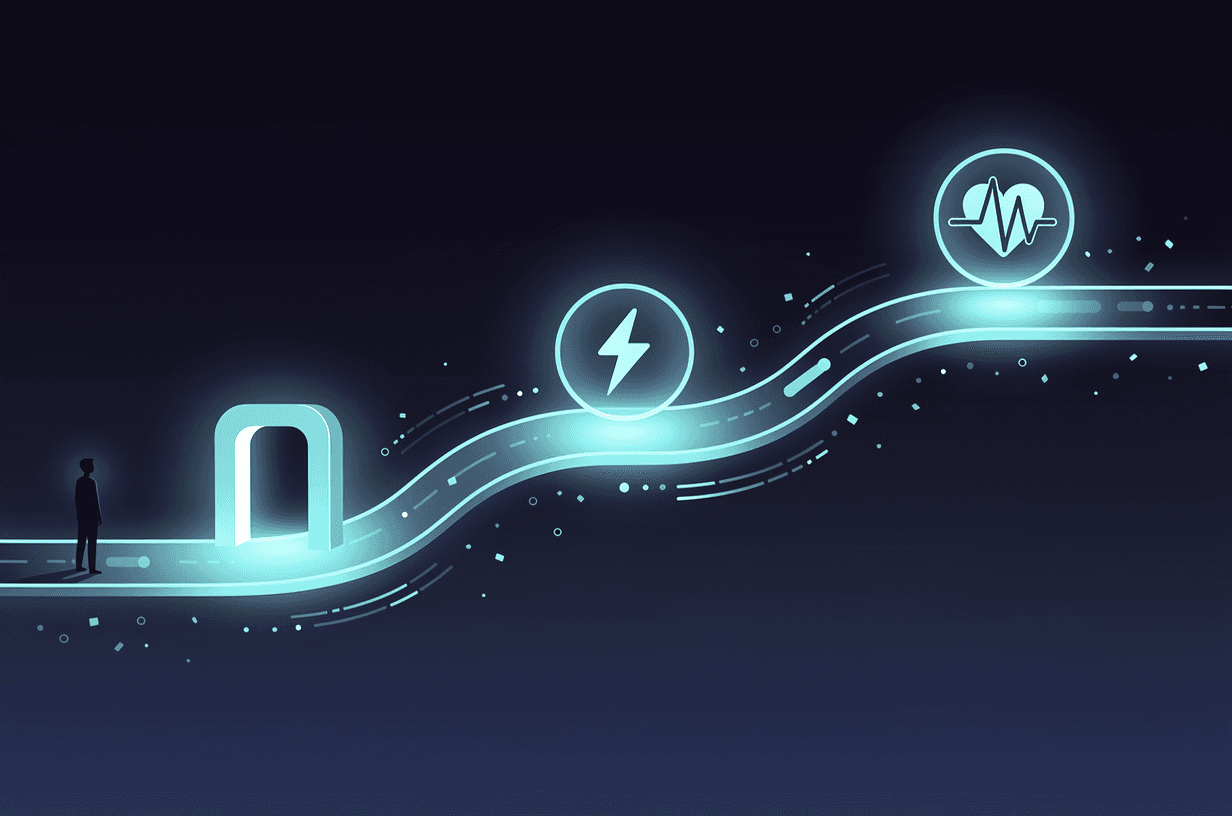
Onboarding is the bridge between signup and value. It is where users decide — consciously or not — whether your product is worth their time. Get it right and you have a retained customer. Get it wrong and you have a churn statistic.
This is not about tooltip tours or welcome emails. It is about designing a deliberate path from first click to the moment a user thinks "I need this."
The Metrics That Matter
Before optimizing onboarding, define what success looks like. These are the metrics that separate SaaS products with 5% free-to-paid conversion from those with 25%:
Time to Value (TTV)
How long does it take a new user to experience the core value of your product? Slack's TTV is measured in minutes — send a message, get a reply. Figma's TTV is a few minutes — create a design, share a link. If your TTV is measured in days or weeks, your onboarding has a structural problem.
Target: reduce TTV to under 5 minutes for the primary use case.
Activation Rate
What percentage of signups complete the critical actions that predict long-term retention? This requires defining your activation event — the specific behavior that correlates with retention. For a project management tool, it might be "created a project and invited a team member." For an analytics tool, it might be "installed the tracking script and viewed the first report."
Benchmark: 20–40% activation rate for B2B SaaS. Top performers hit 60%+.
Day 1 / Day 7 / Day 30 Retention
- Day 1 retention measures first-session stickiness. Did the user come back within 24 hours? Target: 40%+.
- Day 7 retention measures habit formation. Has the product become part of their workflow? Target: 25%+.
- Day 30 retention measures product-market fit. Are they still using it a month later? Target: 15%+.
These cohort metrics are more honest than total signup counts. Track them from day one, even during your MVP phase. Our guide on product-market fit metrics covers how to instrument these measurements properly.
Setup Completion Rate
What percentage of users complete the full onboarding sequence? If you have a 5-step setup flow and 70% drop off at step 3, you know exactly where to focus. Track each step independently.
The Four Onboarding Patterns
Pattern 1: Progressive Disclosure
Show users only what they need at each stage. Hide advanced features behind progressive levels of engagement. This prevents overwhelm — the primary reason users abandon new products.
How it works:
- First session: show only the core workflow (create, edit, share)
- After first success: introduce a secondary feature (collaboration, templates)
- After repeated use: surface advanced features (automation, integrations, analytics)
Who does it well: Notion starts with a blank page and a slash command. The entire feature surface — databases, embeds, formulas, API — is hidden until the user is ready. Linear starts with a single project and reveals team features, cycles, and roadmaps as usage grows.
When to use it: Complex products with broad feature sets. If your MVP has more than 5 distinct features, progressive disclosure prevents the "too many buttons" problem.
Implementation tip: Use feature flags tied to user behavior events. When a user completes action X three times, unlock feature Y. This is not just UX — it is infrastructure. Build the flagging system into your tech stack from the beginning.
Pattern 2: Checklist-Driven
Give users an explicit list of setup tasks. Visible progress creates momentum. Completion creates satisfaction.
How it works:
- Present a 4–6 item checklist after signup
- Each item is a specific, completable action ("Add your first project," "Invite a team member," "Connect your calendar")
- Show progress visually (progress bar, checkmarks)
- Celebrate completion (confetti, congratulations message, unlock a feature)
Who does it well: As Appcues' onboarding research documents, Stripe's developer onboarding uses a checklist: create account, get API keys, make test payment, go live. Each step has clear documentation and a success state. HubSpot's onboarding checklist guides users through CRM setup with specific, measurable tasks.
When to use it: Products that require configuration before value delivery. If users need to import data, connect integrations, or configure settings before the product works, a checklist keeps them on track.
Implementation tip: Limit the checklist to 4–6 items. More than 6 creates the same overwhelm you are trying to avoid. Each item should be completable in under 3 minutes. If an item takes longer, break it into sub-steps or defer it to post-onboarding.
Pattern 3: Value-First Demo
Let users experience the product's value before asking them to configure anything. Show the output before requiring the input.
How it works:
- Pre-populate the account with sample data
- Show what the product looks like when fully configured
- Let users interact with the demo environment
- Then prompt them to create their own content
Who does it well: Airtable pre-populates templates that users can explore before building their own bases. Canva shows a finished design and lets users modify it before creating from scratch. Amplitude provides a demo dashboard with real-looking analytics data.
When to use it: Products where the value is visual or experiential. If a user cannot understand your product's value from a description but would instantly understand it from a 30-second interaction, lead with the demo.
In the AeroCopilot aviation platform, pilots see a pre-filled flight plan with real airport data, weather conditions, and fuel calculations before they create their own. The "aha moment" is seeing a complete, regulation-compliant flight plan — not filling out a form. The same principle applied across completely different domains: show the output, then teach the input.
Pattern 4: Interactive Tutorial
Guide users through their first workflow step by step, with contextual instructions embedded in the UI.
How it works:
- Highlight the next action with a spotlight or tooltip
- Provide context for why each step matters
- Let users complete real actions (not simulated ones)
- End with a tangible result they created
Who does it well: Duolingo's onboarding is a language lesson — you learn by doing, not by reading instructions. Figma's interactive tutorial walks users through creating a real design with real tools. GitHub's "create your first repository" flow teaches Git concepts through action.
When to use it: Products with a learning curve where the workflow is not immediately intuitive. If users need to learn a new mental model (version control, database schemas, flight planning), interactive tutorials are more effective than documentation.
Implementation tip: Never use a simulated environment. Users should complete real actions that produce real results in their actual account. Simulated tutorials teach users to dismiss tutorials, not to use your product.
Designing the First 5 Minutes
The first 5 minutes after signup determine everything. Here is the framework:
Minute 0–1: Remove Friction
- Do not require email verification before access. Let users in immediately. Verify email in the background.
- Do not ask for a credit card on free trials. The conversion uplift from requiring cards (higher quality leads) rarely outweighs the volume loss (50–60% fewer signups).
- Minimize the signup form. Name, email, password. Everything else can come later. Every additional field reduces signups by 10–15%.
- Use social login. Google and GitHub OAuth reduce signup to a single click. Our security checklist covers implementing OAuth securely.
Minute 1–3: Personalize the Path
Ask 1–2 questions that customize the onboarding experience:
- Role: "Are you a developer, designer, or manager?" This determines which features to highlight first.
- Goal: "What do you want to accomplish first?" This determines the tutorial path.
- Team size: "Are you working solo or with a team?" This determines whether to show collaboration features.
Do not ask more than 2 questions. Every question adds friction. Use the answers to route users to different onboarding paths — not to build a marketing profile.
Minute 3–5: Deliver the Aha Moment
Guide the user to complete one meaningful action that demonstrates core value. This is your activation event. Everything in the first 5 minutes should serve this single goal.
Examples:
- Analytics tool: Install the script and see the first pageview appear in real time
- Project management: Create a task and move it to "done"
- Email marketing: Send a test email to yourself and see it in your inbox
- Code editor: Open a project and get an AI suggestion that saves time
If a user completes this action, they are 3–5x more likely to become a paying customer than if they do not. Instrument this event. Measure it. Optimize everything upstream of it.
Onboarding Anti-Patterns
The Feature Tour
A modal carousel showing 8 screenshots of features the user has not used yet. Nobody reads these. Nobody remembers them. They train users to click "Skip" as fast as possible. Delete every feature tour in your product.
The Empty State Desert
A user signs up and sees an empty dashboard with no guidance. "No projects yet. Create one to get started." This is not onboarding — this is abandonment. Every empty state should include a clear call to action, sample content, or a guided path forward.
The Email Drip Instead of Product Experience
Sending a 7-day email sequence to teach users your product instead of teaching them inside the product. Emails supplement onboarding; they do not replace it. If your onboarding depends on users opening emails, your onboarding is broken.
The Everything-at-Once Dashboard
Showing every feature, metric, and option on the first screen. Dashboards are for power users who understand the data model. New users need a single, focused task — not a cockpit of 47 widgets.
Measuring and Iterating
Onboarding is never finished. It is the highest-leverage optimization surface in your product because it directly impacts every downstream metric — activation, retention, conversion, expansion.
Instrument Everything
Track every step of the onboarding flow as discrete events:
signup_completedonboarding_step_1_started,onboarding_step_1_completedactivation_event_completedonboarding_skipped(and at which step)
Use these events to build a funnel analysis. Identify where users drop off. A/B test the step with the highest drop-off rate. When tracking startup metrics, onboarding funnel completion should be a primary dashboard metric.
Run Cohort Analysis
Compare onboarding performance across weekly cohorts. Did last week's change to step 3 improve completion rates? Did the new welcome video reduce Day 1 retention (because users watched instead of acted)? Cohort analysis reveals whether changes actually improve outcomes or just feel like improvements.
Talk to Churned Users
The most valuable feedback comes from users who signed up and left. Send a brief survey (1–2 questions) 48 hours after signup to users who did not activate. "What prevented you from getting started?" The answers will reveal onboarding barriers that analytics cannot detect — confusing terminology, missing integrations, unclear pricing, or simply "I forgot."
The Revenue Impact
According to benchmarks from UserPilot and Appcues, a 10% improvement in activation rate typically produces a 10–15% increase in revenue — without spending more on acquisition. For a SaaS product spending $50K/month on marketing, improving onboarding is equivalent to a $5K–7.5K/month marketing budget increase, but with compounding effects.
Every user you activate today retains, expands, and refers tomorrow. Onboarding is not a UX project. It is the most important revenue lever in your SaaS business.
Build it deliberately. Measure it obsessively. Iterate on it weekly. The 60% of users who leave after one session are not lost causes — they are an opportunity you have not seized yet.